A skin sample can provide a precise measurement without answering the question that brought someone to a wrinkle study. How tissue changes, how a face appears under assessment and whether a person notices a worthwhile difference are three separate outcomes. Reading them together is useful, but moving from one to another requires evidence connecting the measurements. A numerical result does not provide that connection merely because it looks objective.
This article examines that connection through tretinoin research and related retinol evidence. The aim is to identify what each measurement represents, distinguish changes in units from changes in appearance, and ask how a future study could connect laboratory findings with experience. The arithmetic example below is invented for explanation. It is neither a reconstruction of participant data nor a prediction about a cream.
Study figure and data
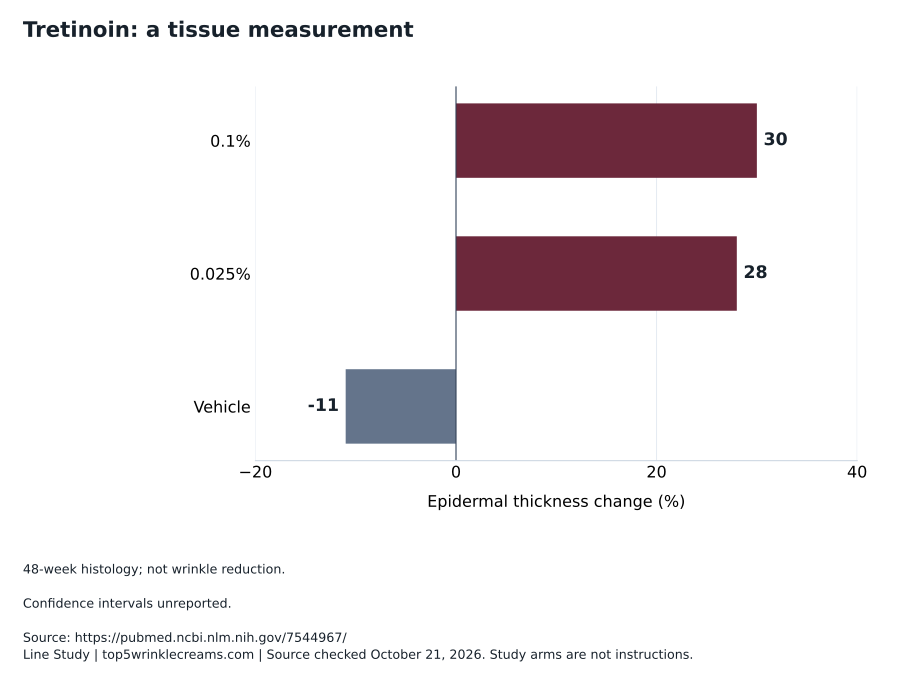
Tretinoin: a tissue measurement
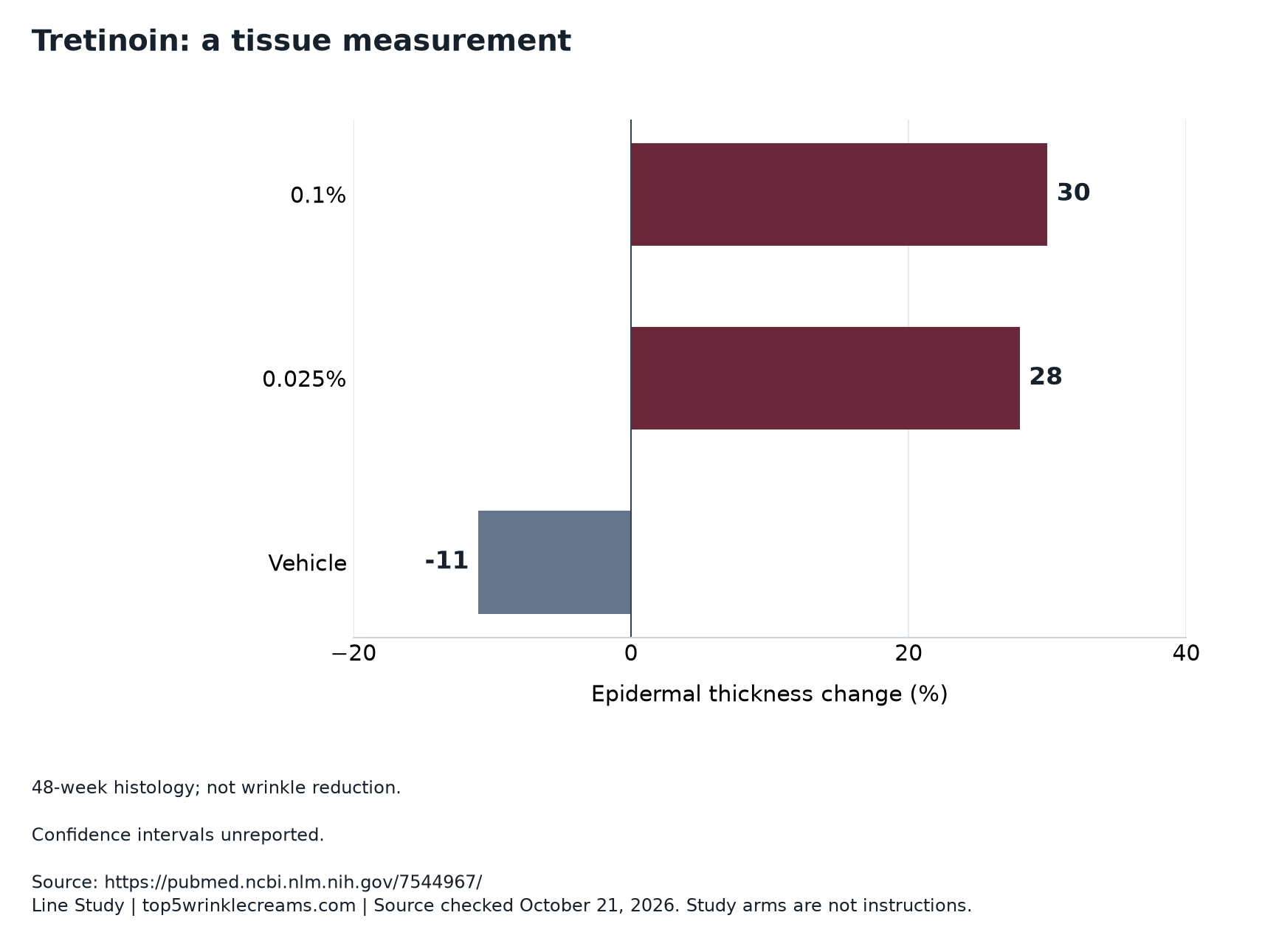
48-week histology; not wrinkle reduction.
Confidence intervals unreported.
Download chart (PNG)Download data (CSV)Download vector chart (SVG)
| Study arm | Reported value |
|---|---|
| 0.1% | 30 |
| 0.025% | 28 |
| Vehicle | -11 |
Start with the measured outcome
The indexed 1995 abstract describes a 48-week, double-blind cream comparison in photoaged participants: 99 completers, comprising 32 using 0.1% tretinoin, 35 using 0.025%, and 32 using vehicle. Active concentrations had similar facial clinical improvement; the higher concentration caused more erythema and scaling.
There are several distinct questions inside such a comparison. A clinical assessment asks about a feature an evaluator can judge. A tissue assessment asks about a specified feature of a sample. An irritation assessment describes a burden associated with treatment. Combining those findings into a single favorable adjective would discard information. Keeping separate outcome names makes it possible to recognize a benefit while still examining its costs in discomfort.
Before interpreting a chart, finish this sentence: the plotted value represents a change in what? Then identify the reference value, observation time and comparison group. These steps prevent a tissue percentage from becoming a percentage of wrinkles removed in a reader’s mind. The guide to reading wrinkle-cream study claims provides a broader framework for checking the match between a study’s actual endpoint and the language used to describe it.
A biopsy, a rating and an experience
A biopsy examines a small piece of tissue. An appearance assessment evaluates a visible feature within a defined area. A participant report asks what the person experienced or valued. These approaches observe different aspects of the same treatment question. Greater technical precision in one measurement does not automatically make it the best answer to another question. The appropriate measure depends on the claim being tested.
Consider a hypothetical study with a laboratory signal, standardized photographs and a satisfaction questionnaire. Agreement across those observations would be informative. Disagreement would also deserve investigation: perhaps the visible change is too subtle to matter to participants, or perhaps their priorities concern comfort rather than the photographed feature. Those are possible explanations to test, not conclusions available from the mere presence of multiple measurements.
The table separates the questions without ranking one type of evidence as universally superior. It also shows why an account of hydration and wrinkle expectations should name the outcome under discussion. A temporary appearance judgment, a tissue result and a durable perceived benefit would need their own observations. An attractive biological explanation cannot supply measurements that were never collected.
| Question | Relevant observation | Additional evidence needed |
|---|---|---|
| What changed in the sampled tissue? | A defined laboratory measurement | Sampling location and measurement repeatability |
| What changed in visible appearance? | A standardized investigator assessment | Masking, rating rules and comparable conditions |
| Did the change matter to the participant? | A clearly worded participant report | The person’s priorities and interpretation of change |
The same gain can produce two percentages
Here is an entirely invented example using made-up thickness units. Person A starts at 100 units and gains 20, ending at 120. Person B starts at 200 and gains 20, ending at 220. Relative to their own starting values, the increases are 20% and 10%. The absolute gain is identical. These fictional values describe no trial participant, actual skin measurement or expected treatment effect.
The calculation divides the gain by the starting amount, then multiplies by 100. Changing the denominator changes the percentage even when the numerator stays fixed. Therefore, a larger relative increase does not, by itself, mean a larger absolute increase. Nor does it identify a better clinical outcome: no appearance rating or participant judgment has been supplied in this example. There is nothing here from which to calculate wrinkle reduction.
A group summary introduces another choice. Averaging each person’s percentage change and calculating a percentage change from group averages can yield different answers. A reader needs the report’s definition before treating those summaries as interchangeable. The illustration is useful because it exposes the missing information directly: units, baselines and outcome definitions must accompany a percentage before its meaning can be evaluated.
| Fictional person | Starting and ending units | Relative change |
|---|---|---|
| Person A | 100 → 120 | 20% |
| Person B | 200 → 220 | 10% |
A group pattern is not a personal connection
Suppose a future study reports that a treated group has both a larger tissue change and a better appearance score than its comparator. Those group summaries would establish two observed patterns. They would not reveal whether the people with the largest tissue changes also had the largest appearance changes. The latter question requires linked measurements for each person, preserving who contributed each observation.
Even a relationship within individuals would need interpretation. A common starting condition could influence both measurements. Measurement error could weaken a real association or create misleading patterns if assessments share a source of bias. A useful analysis would examine starting values, timing and uncertainty, rather than arranging two group averages side by side and assuming a biological chain has been demonstrated.
A still stronger claim would propose that the tissue measure can stand in for a clinical outcome. That would require validation beyond showing that the two sometimes move together. Researchers would need to examine whether treatment-related changes in the measure reliably predict treatment-related changes in the outcome across relevant settings. An association, a proposed mechanism and a validated substitute endpoint are different claims, with progressively more demanding evidence requirements.
Reliable measurement begins before the result
Repeatability asks whether the same method gives sufficiently similar results when the underlying feature has not changed. For a tissue measurement, a study could evaluate variation introduced by sample selection, processing and reading. For an appearance rating, it could assess agreement between evaluators and consistency within an evaluator. These are general design questions, not assumptions about methods omitted from an accessible report.
Standardization makes comparisons interpretable. Imagine before-and-after photographs taken under different lighting or facial expressions: the observed difference could combine the feature of interest with changes in observation conditions. Holding those conditions consistent would help isolate the intended comparison. Masking assessors to treatment assignment addresses another problem, expectations influencing judgments. Neither step guarantees perfect measurement; each targets a particular potential source of error.
Prespecifying the primary outcome gives the analysis a defined question before investigators see the results. Additional measurements can still be valuable, but readers should know whether a finding answers that original question or arose during exploration. This distinction also matters when evaluating headlines about faster improvement or looking younger. A memorable label should not replace the actual rating procedure, observation schedule and rules used to select the reported result.
Irritation and appearance need separate comparisons
Finding similar observed appearance outcomes does not establish that two treatments are equivalent. An equivalence claim needs a justified range of differences considered acceptably small and an analysis capable of evaluating that range. A study may fail to detect a difference for several reasons, including limited precision. That statistical result alone does not identify how close the treatments truly are.
A separate irritation result addresses a different endpoint. It may influence how a participant values treatment even when the appearance comparison looks similar. However, it does not identify which concentration an individual should use. Such a decision would require clinical context and product-specific information that a comparison of group outcomes cannot supply. Historical study arms are descriptions of research, not instructions for choosing a regimen.
Nor does a contrast in irritation automatically prove how visible improvement occurred. To investigate whether irritation mediates an effect, researchers would need an explicit causal question, suitable measurements and assumptions addressing alternative explanations. Simply observing both outcomes does not isolate the pathway between them. The companion article about retinol study scores considers another interpretive problem: what an average can leave unresolved about the distribution and meaning of individual changes.
Follow the people behind each measurement
Kafi’s full article studied laboratory 0.4% retinol on randomized, paired upper arms in 36 people averaging 87; 23 completed, 13 withdrew, three for irritation. Analysis carried earlier observations forward. Four inventors had conditional patent royalty interests; a separate funding statement was not located.
A paired design compares observations linked within a person. Treating both sides as unrelated participants would erase that structure. Similarly, a laboratory subset and a clinical sample should not silently become the same denominator. To connect their results, a reader would need to know who contributed each measurement, whether observations were made at comparable times and how incomplete records entered the analysis.
Carrying an earlier observation forward fills a later data slot with a recorded earlier value. It does not turn that earlier value into a newly observed endpoint. Interpretation therefore depends partly on what happened after observation stopped. A useful sensitivity analysis would explore plausible alternatives for missing outcomes. Likewise, a study designed to connect biopsies with appearance should account for people who decline a biopsy or leave follow-up, because a neatly matched subset may not represent everyone originally studied.
Keep the formulation attached to the evidence
RENOVA’s current label concerns 0.02% tretinoin cream as an adjunct for fine facial wrinkles alongside comprehensive skin care and sunlight avoidance. Its evidence limits beyond 52 weeks and over age 71 are formulation-specific.
A different 2005 report concerns a two-year 0.05% emollient-cream comparison in 204 treated participants. The accessible abstract and acknowledgment document OrthoNeutrogena support and author financial relationships; full methods and results were not reviewed.
These records illustrate why an ingredient name is an incomplete description of an intervention. Concentration, formulation, study population and assessed outcome each belong to the evidence being interpreted. Combining a time limit from one record with a population from another would create a claim neither record independently supports. An evidence comparison should preserve those identities before asking whether any finding is relevant to another product.
Our editorial interpretation is that purchasing research needs a separate documentary check. The retinol or prescription guide helps frame that distinction. The CoreAge Rx review and Musely review are places to examine documented purchasing and service terms. These links do not establish that either provider supplies a trial formulation or reproduces a study’s outcomes. Evidence about a cream and evidence about a commercial service answer different questions.
Design a study that connects the outcomes
A future validation study could begin by specifying the appearance change it intends to explain and the experience it hopes to understand. Researchers could collect tissue measurements, blinded appearance ratings and participant reports at planned times in the same people. The protocol would define these measures before results were known and distinguish the main question from exploratory laboratory analyses.
A participant anchor would be an independent question about experienced change, used to help interpret what a score difference means. Its wording and relevance would matter. Satisfaction with an entire routine, for example, would not necessarily isolate a change in fine lines. Investigators would need to show that the anchor measures an appropriate concept and relates meaningfully to the score under evaluation.
No numerical threshold should be declared meaningful simply because it was convenient for planning a study’s size. A statistical power assumption serves a design calculation; a noticeable or worthwhile difference needs separate validation. Researchers could examine agreement, disagreement and uncertainty across the three outcome types, then test the findings in a new sample. This would make the proposed connection open to correction instead of treating biological plausibility as the final answer.
Read the headline back to its evidence
Start with the claim’s noun: thickness, staining, wrinkles, satisfaction or another named outcome. Next identify its unit and denominator. Then locate the body area, population, comparator and observation period. Each step narrows the question to something the research could actually address. If a headline changes the noun halfway through its explanation, trace the missing connection before accepting the conclusion.
Read the uncertainty beside the estimate, not as an optional footnote. Ask whether the result describes a group summary, a within-person comparison or a subset selected for a particular measurement. Look for a clear account of missing observations and for boundaries on source access. A detailed abstract can support useful interpretation while still leaving questions that require the complete report or participant-level data.
Finally, separate an evidence judgment from a personal treatment choice. An article can clarify what a study measured without selecting a product or prescribing an application schedule. For practical context, the guide to a manageable wrinkle-care routine addresses the broader routine question. Keep the research question visible throughout: what changed, how was it measured, and what evidence connects that change to the outcome the reader actually values?
Questions about the evidence
Does a thicker tissue sample mean fewer visible wrinkles?
The quantities describe different outcomes. A convincing connection would require linked tissue and appearance measurements, a clear analysis and evidence that the relationship holds in the setting being discussed. The invented percentage example supplies no appearance data, so it cannot rank visible benefit.
Why does the starting value matter so much?
Relative change divides the gain or loss by the starting value. The same absolute gain therefore produces different percentages when baselines differ. Knowing the arithmetic still does not identify whether the measured change matters clinically; that requires evidence about the relevant outcome.
Could participant experience disagree with an investigator rating?
Yes, conceptually they can answer different questions. A person may prioritize comfort or a particular visible feature that a rating does not capture. A study should define both concepts clearly and investigate disagreement rather than assuming either observation automatically invalidates the other.
Would a precise laboratory result settle a product comparison?
Precision concerns the uncertainty of a specified measurement. It does not establish that the measurement answers the purchasing question, represents a different formulation or predicts personal benefit. Product identity and relevance remain necessary even when a laboratory estimate appears very precise.
What would make a proposed mechanism more convincing?
A useful next step would connect measurements within individuals, establish their timing, examine alternative explanations and test whether findings repeat. Showing that a treatment changes two outcomes is a starting observation. Demonstrating that one change explains the other requires a stronger design and additional assumptions.
Editorial assessment
Line Study’s interpretation is to keep biological observations, assessed appearance and participant experience distinct until evidence connects them. Read the chart as the quantity named on its axis. Preserve the original comparison and denominator. Ask what information would be needed to translate that result into a claim about visible or worthwhile improvement. This approach makes laboratory findings useful without requiring them to answer every clinical question. It also leaves room for informative disagreement between measurements, which can guide better research rather than being hidden by a single promotional percentage.
Research access and limitations
The 1995 abstract leaves allocation, initial enrollment, attrition, biopsy location, confidence intervals and funding unestablished. Kafi reported only significant biopsy effects. No protocols, individual records or supplements were examined. Invented arithmetic illustrates interpretation only; it provides no treatment recommendation.
Sources and access notes
- Two concentrations of topical tretinoin (retinoic acid) cause similar improvement of photoaging but different degrees of irritation. A double-blind, vehicle-controlled comparison of 0.1% and 0.025% tretinoin creams.
Indexed original research abstract · Checked October 21, 2026
- Improvement of naturally aged skin with vitamin A (retinol).
Full publisher research article, including original clinical table-image footnote, figure captions, Comment and Financial Disclosure; no supplements or individual data reviewed. · Checked October 21, 2026
- DailyMed - RENOVA- tretinoin cream
Official current labeling retrieved in full · Checked October 21, 2026
- Long-term efficacy and safety of tretinoin emollient cream 0.05% in the treatment of photodamaged facial skin: a two-year, randomized, placebo-controlled trial.
Indexed original research abstract plus publisher acknowledgment and financial disclosures; full methods and results not reviewed. · Checked October 22, 2026